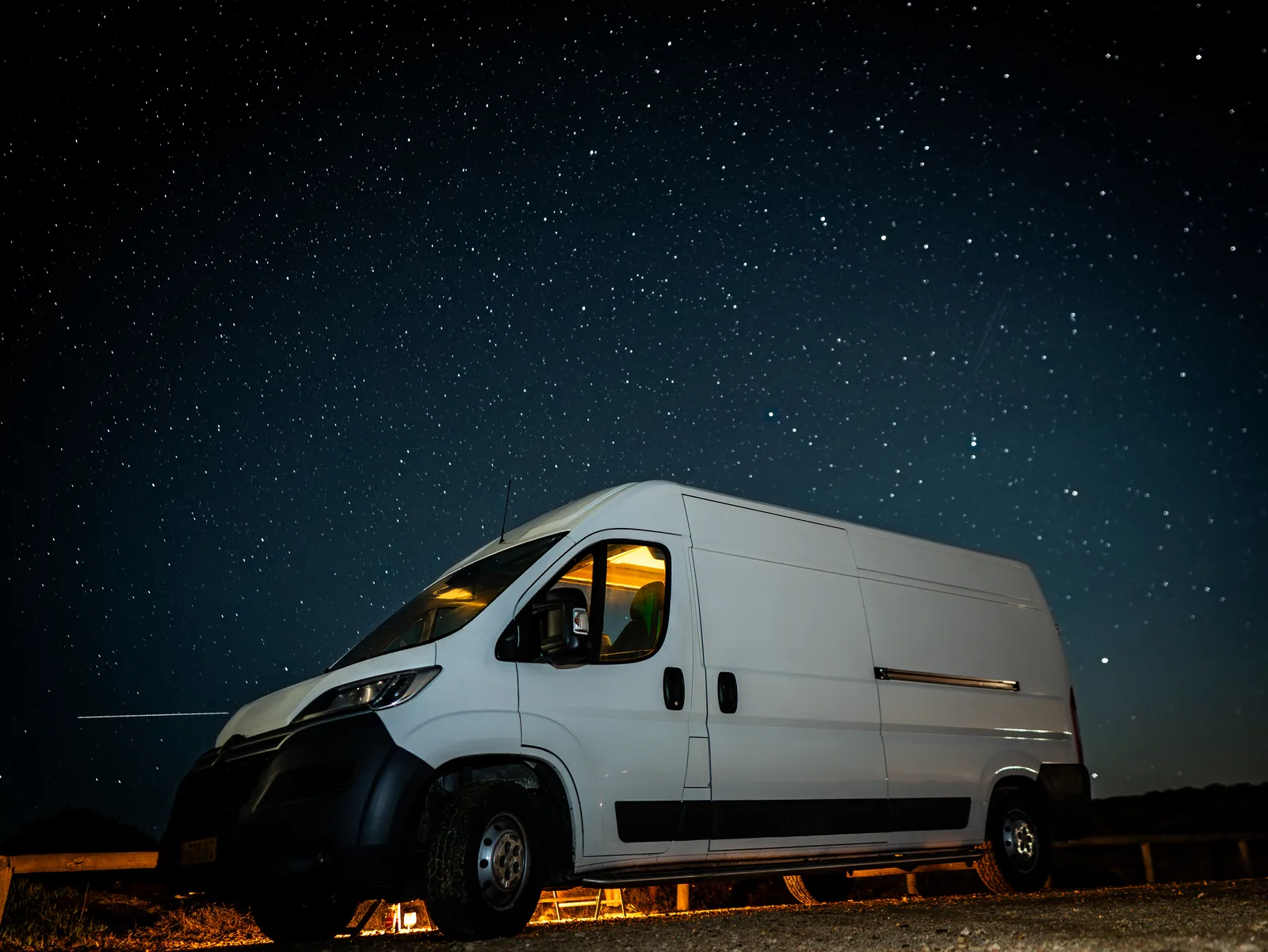
One of the most underrated advantages of a fully off-grid campervan: you can park anywhere it's dark. No campsite with irritating exterior lights, no generator from the neighbours. The best night skies are found in exactly the places that are also ideal for wild camping, remote, quiet, and far from the city.
Below you'll find the best stargazing spots by country, with practical information for campervan travellers. The Horizon is equipped with 600W solar panels and is perfect for an off-grid adventure trip through Europe. We end with the astronomical event of this decade: the total solar eclipse of 12 August 2026 in Spain.
🇳🇱 Dark Sky spots in the Netherlands
Friesland / Groningen, near Lauwersoog
The first official Dark Sky Park in the Netherlands on the mainland. The national park has two sky platforms, observation towers with lying boards so you can watch the stars lying down without neck pain. On clear nights the Milky Way is visible to the naked eye. During active aurora activity even the northern lights can be seen here.
Wadden Island Terschelling
De Boschplaat is the first and darkest official Dark Sky Park in the Netherlands, one of the darkest places in all of Western Europe. The combination of dunes, sea and a night sky with zero light pollution is unforgettable. Climb a dune top, let your eyes adjust to the dark for half an hour and you'll discover stars you never see in the city.
Friesland / Drenthe
Zwarte Haan is a tiny hamlet at the end of a dead-end road in Friesland, right on the outer dyke. Total darkness, total silence. In Drenthe, Appelscha is an excellent alternative: wooded surroundings, little industry nearby, and easy to reach. The open heathlands to the south of the Fochteloërveen give a wide view of the sky.
🇩🇪 Dark Sky spots in Germany
North Rhine-Westphalia, near Monschau and Gemünd
Germany's first and most famous Dark Sky Park, less than 3 hours' drive from Amsterdam. Surrounded by major cities like Cologne, Bonn and Aachen, yet remarkably dark thanks to an active policy against light pollution. The park organises stargazing walks and astronomy events. Right on the Belgian border, so easily combined with a route through the Ardennes.
Bavaria / Hesse / Thuringia, central Germany
The Rhön is known as the "land of endless views", vast mountain meadows up to 950 metres in altitude, virtually no development and a sky recognised by the Dark Sky Association as exceptionally dark. Less well-known than the Eifel, so also less visited. Ideal for the longer road trip that also deserves the Horizon.
🇧🇪 Dark Sky spots in Belgium
Province of Liège, near Bütgenbach and Baraque Michel
Belgium has no officially certified Dark Sky Park, but the Belgian Eifel and the High Fens plateau border directly on the German Dark Sky Park and benefit from the same protected dark-sky policy. The High Fens is Belgium's highest plateau (694 metres) and offers an unobstructed view of the sky. The combination with the Ardennes makes it ideal for a weekend trip from Amsterdam.
🇫🇷 Dark Sky spots in France
Gard / Lozère, southern Massif Central
The Cévennes is the largest Dark Sky-certified area in Western Europe and ranks among the darkest places on the continent. The park is enormous, larger than the whole of North Holland, with virtually no artificial light. On clear nights not only the Milky Way but also the so-called "zodiacal light" and even the Andromeda galaxy are visible to the naked eye. In summer the park organises night walks with astronomers.
Hautes-Pyrénées, near Bagnères-de-Bigorre
At 2,877 metres stands a professional observatory with a history as a military lookout post. Accessible by cable car; the observatory also offers overnight stays for tourists including dinner, stargazing through professional telescopes and a sunrise above the clouds. Places are limited, book months in advance. The surrounding valleys are also excellent for campervans who want to observe the night sky.
Mark in your calendar
The 2026 Total Solar Eclipse
Wednesday 12 August 2026, Northern Spain
The first total solar eclipse over continental Europe in 27 years will draw a narrow path of total darkness across northern Spain on 12 August 2026, from the Atlantic coast near Galicia to the Mediterranean near Valencia and Mallorca. The sun sinks just above the western horizon as the moon covers it completely: a dramatic spectacle that lasts less than three minutes but stays with you for a lifetime.
Cities in the path of totality
Campervan tip for the eclipse
The best spots are those with an unobstructed view of the western horizon, the sun is only 4 to 10 degrees above the horizon at totality. The Bardenas Reales region in Aragon (an almost lunar desert landscape) and the Ebro plain near Zaragoza have the highest chance of clear skies and sit centrally within the path of totality. Book your campervan pitch or farm stay via France Passion or Campspace, accommodation in the path is already pricier than usual and books up fast. Madrid and Barcelona lie just outside the path, but the region in between is ideal. On the day itself, drive flexibly with the weather forecast, an off-grid campervan gives you exactly that freedom.
Practical tips for stargazers with a campervan
Choose new moon
A full moon is the biggest competitor of the night sky. Plan your stargazing night around new moon, the lunar calendar can be found via apps like Stellarium or Moon Phase.
Give your eyes time
It takes 20–30 minutes for your eyes to fully adapt to the dark. Don't use your phone screen or torches in that time, or at least no white light. Red light is less disruptive.
Use Stellarium
Stellarium is the best star app for iOS and Android. Hold your phone up and the app shows exactly which stars, planets and constellations you can see. Indispensable for beginners.
Check Clear Outside
Ordinary weather forecasts are not sufficient for stargazers. The Clear Outside app provides an hourly detailed cloud cover forecast specifically for astronomy.
Binoculars are enough
You don't need a telescope to see impressive things. An 8×42 pair of binoculars already reveals Jupiter's moons, the Pleiades star cluster and the structure of the Milky Way.
Dress warmly
Even in summer it cools down significantly at night outside the city. The Webasto heating in our campervans ensures you come back warm, but bring warm clothing for outside too.
Further reading
Off-grid, where the stars shine brightest
Our campervans are fully self-sufficient, no campsite needed, no hookup required. You choose the spot, we take care of the rest.
Hire a campervan in AmsterdamNightlapse from the mountains of Portugal
Here is a nightlapse filmed by Koen with the Horizon campervan in the mountains of Portugal.